
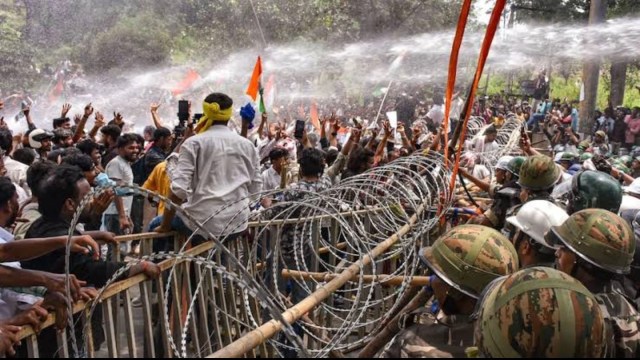
Jharkhand protests over alleged paper leaks in JPSC and JSSC exams entered their 17th day on today. Thousands of job aspirants marched towards the Jharkhand Assembly in Ranchi and faced water cannons and lathi charges, even as Chief Minister Hemant Soren’s government claimed it had accepted most of their demands. The clash matters because it involves lakhs of young job seekers, a state government fighting to control the narrative, and questions about who can be trusted to investigate the state’s own recruitment bodies.
What sparked the Jharkhand protests?
The trouble began with the 14th JPSC Combined Civil Services Preliminary Examination. It was held on April 19, 2026, and more than 36,000 candidates appeared for it. When results came out on July 2, aspirants noticed something was wrong.
Against just 103 advertised vacancies, 2,204 candidates were declared qualified for the Mains. Category wise cut off marks were missing. The merit list did not carry the signatures of Commission members. Then a photocopy of a successful candidate’s OMR answer sheet went viral online. It showed the candidate had attempted only 48 of 100 questions in Paper 1, well below the 144 marks needed to qualify, yet the candidate still cleared the exam.
That single image turned quiet frustration into a full blown movement.

Did the Jharkhand police use excessive force on unarmed students marching to the assembly?
On August 10, students marched from the old Assembly building towards the new complex. Police used water cannons and lathi charges once the crowd broke through barricades near Jagannathpur Temple, on a day that also happened to be Chief Minister Hemant Soren’s birthday.
Student protester Vikram Kumar, who was injured in the action, told reporters the crowd had not turned violent before police moved in. He alleged the police acted suddenly despite the demonstration remaining peaceful, and said protesters had neither abused personnel nor engaged in violence beforehand.
Whether the force used was proportionate is now part of the political argument in these Jharkhand protests, with the opposition calling it heavy handed and the administration citing the barricade breach as the trigger.
Why won’t the Jharkhand government agree to a CBI probe?
This is the single biggest sticking point. The state government has instead relied on its own Criminal Investigation Department. The CID has been active, arresting people and seizing evidence, but students say a state agency cannot fairly probe a state run commission.
The CID’s findings so far are serious. Investigators identified Abhay Kumar Tiwari as a key accused who had cleared 12 competitive examinations over 13 years, with his wife and brother also holding government jobs. By last week, the CID’s arrest count had touched 19 people, including officials linked to the former JPSC chairman and employees of the exam conducting agency.
A central thread in the probe is how the exam contract reached TSR Data Processing Private Limited, commonly called TDPL. The Lucknow based firm had reportedly been blacklisted by the JSSC in May 2025 over allegations of irregularities and breaches of confidentiality, yet it was still entrusted with conducting the 14th JPSC examination, a decision now under scrutiny.
CID probe or CBI probe: What is the real difference?
A CID probe is run by a state police wing that reports to the state government, the same government whose appointees and processes are under the scanner here. A CBI probe is conducted by a central agency operating under separate central oversight, which protesters see as offering more independence and public credibility, even though CBI investigations too can take years to conclude, as the 2012 JPSC case shows.
Six rounds of talks, still no deal. What happened?
The Soren government did not ignore the protest. Ministers held round after round of dialogue, first with the JPSC JSSC Reforms Manch and then with other student bodies including NSUI, Jharkhand Chhatra Morcha and Adivasi Chhatra Sangh.
By Sunday, August 9, six rounds of talks had taken place. Rural Development Minister Dipika Pandey Singh, part of the government’s panel, told PTI the panel had briefed the Chief Minister on students’ demands after five rounds of dialogue, and a final round was fixed for noon on Sunday.
The sixth round still failed to close the gap. State minister Sudivya Kumar Sonu announced a package: cancellation of the 14th JPSC prelims and the 2023 and 2025 backlog exams, a CID probe, an Enforcement Directorate investigation into financial angles, a fast track court, and an expert committee involving IIT ISM, IIM Ranchi, XLRI and reportedly XISS to redesign recruitment procedures.
The government claimed it had met 98 percent of demands. Students disagreed. Sonu said the government could not unilaterally cancel the CGL examination because it was being conducted under directions from the High Court and Supreme Court and remained under judicial monitoring. Instead, it offered a monitoring committee headed by a retired judge, an offer students rejected.

Is Hemant Soren’s government losing control of the narrative?
The optics have not helped the ruling JMM led coalition. Three JPSC members, Ajita Bhattacharya, Anima Hansda and Jamal Ahmad, resigned on Sunday after the CID summoned them for questioning. JPSC chairperson L Khiangte had already quit on July 22. That is four resignations from a nine or ten member commission inside three weeks.
Adding to the pressure, the Enforcement Directorate registered a case under the Prevention of Money Laundering Act linked to the JPSC irregularities on the same day students marched to the Assembly. A Public Interest Litigation also reached the Supreme Court, with a plea filed by social worker Harisharan Devgan seeking a CBI investigation into the 14th JPSC exam.
This subject directly tests a promise Soren made when he took oath as Chief Minister in 2024. After being sworn in on November 28, 2024, he said the JPSC and JSSC would issue an exam calendar for all vacant posts and release pending results before January 1, 2025. That deadline came and went, and now the very commissions he vowed to fix are at the centre of Jharkhand’s largest recruitment protest in years.
JLKM’s role: solidarity or political opportunity?
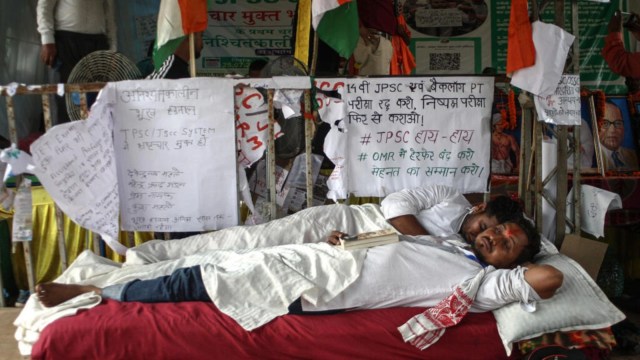
Devendra Nath Mahto, associated with the Jharkhand Loktantrik Krantikari Morcha, has been on an extended hunger strike at Jaipal Singh Munda Stadium. He continued his fast despite chest pain and medical advice to be hospitalized, having only taken water once on the insistence of activist Sonam Wangchuk.

But the protest site has not spoken with one voice. Two camps have agitated separately at the same ground, one led by Mahto and JLKM and the other by the JPSC JSSC Reform Manch, after disagreements over tactics and leadership despite an earlier understanding that no political outfit would lead the movement. The Reform Manch accuses JLKM of trying to take over the agitation for political gain, a charge JLKM denies. This remains an ongoing internal dispute rather than a settled fact, since both camps contest the other’s version.
Why do Jharkhand’s exams keep getting leaked?
This is not new. Jharkhand’s civil service exams have faced repeated controversy since the state was carved out of Bihar in 2000.
- 2003: A History paper leak forced JPSC to cancel and later redo the exam.
- 2012: The CBI eventually filed five cases and, after a 12 year gap, chargesheeted 50 people including a former JPSC chairman, alleging successful candidates were linked to politicians and officials.
- January 2024: The JSSC CGL general knowledge paper, taken by roughly 54,300 candidates across 108 centres for 2,027 posts, was cancelled after answers circulated on WhatsApp before the exam even ended.
- February 2025: JAC class 10 board exams in Hindi and Science were cancelled after papers leaked and went viral, prompting BJP MLAs to disrupt Assembly proceedings.
- 2026: The 14th JPSC prelims controversy, now the biggest of them all.
Each episode followed a familiar pattern of leak, cancellation, an investigation announced, and partial accountability, without the systemic fix aspirants say they actually need.
What happens next?
The government has said its expert committee, expected to draw on IIT ISM, IIM Ranchi, XLRI and possibly XISS, will study how a reformed JPSC and JSSC should function procedurally, including tighter vetting of private exam vendors like TDPL. For now, protest leaders say their agitation, and Mahto’s hunger strike, will continue until a CBI probe is formally ordered. National English language coverage of the standoff has been comparatively muted next to the wall to wall attention the Delhi NEET protests received, a gap regional Hindi outlets and Jharkhand’s own press have been quick to point out. With the Supreme Court now seized of a related plea, the coming days could determine whether Jharkhand’s protest ends in negotiated reform or, like Delhi before it, in a resignation.