
Assam government wants to cut Kaziranga National Park’s protective buffer from 10 kmdown to just 1 km. Chief Minister Himanta Biswa Sarma announced it on August 8 standing in Bokakhat, and said the state would send the proposal to the Centre within two months. He is calling it a technical correction.
Look at everything happening around Kaziranga right now, and it stops looking technical at all.
Wait, why is Kaziranga at 10 km in the first place?
Kaziranga has never had a final Eco-Sensitive Zone notification. Because that process was never finished, the Supreme Court’s default kicked in, and that default is 10 km. In March 2026, the Gauhati High Court checked and confirmed it directly, Assam still had not filed even a draft ESZ proposal, so the 10 km buffer stayed in force.
So yes, technically, nobody is “cutting” a notified zone, because nothing was ever notified. That is the government’s whole legal defence, and it is accurate. But it is also true that the 10 km buffer has been doing real protective work for years, whatever its paperwork status. Swapping it with a technicality, still leaves Kaziranga’s rhinos, elephants and tigers with dramatically less room to move, especially when the Brahmaputra floods every single monsoon and animals need somewhere dry to run to.
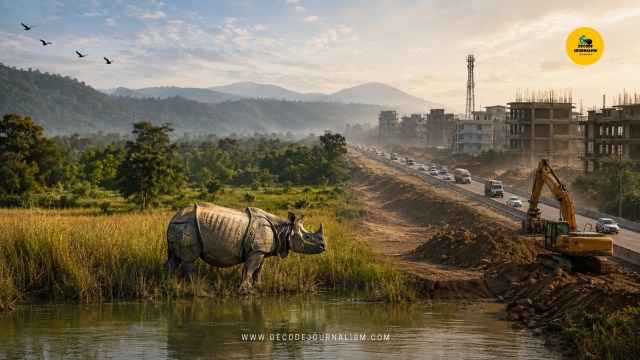
Govt’s argument, and Why it does not hold up fully?
Sarma keeps repeating the same line. He says a 10 km buffer would wipe entire towns off the map, telling reporters that towns like Kaliabar, Doboka, Jakhalabandha and Bokakhat “would not remain” under that limit. He also points out that no wildlife sanctuary anywhere in the world carries a 10 km ESZ, and leans on the Supreme Court’s 2022 order that set 1 km as the number.
Here is what gets left out every time he says this. The Supreme Court set 1 km as a floor, the least a state can get away with, not a target. The same order allows states to go up to 3 km or more depending on the ecology on the ground.
Kaziranga is not some ordinary patch of forest. It is a UNESCO World Heritage Site holding the largest one horned rhino population on the planet, sitting in one of the most flood prone stretches of Assam. If any park in India had a case for going above the bare minimum, it is this one. Picking the smallest number legally possible, for this specific park, is a choice the government made. It is not something the court forced on them.
This is not the first cut…
Rewind to June 2025. Assam quietly withdrew its own 2020 proposal to add 2,570 hectares in Sonitpur district to Kaziranga. That land mattered because it would have connected Kaziranga to the Nameri landscape, closing a real gap in the wildlife corridor. Conservationists objected loudly at the time. The government cancelled it anyway, and the land was simply left with no protection and no follow up plan.
So line it up. First, a planned expansion that would have given Kaziranga’s wildlife more connected habitat gets scrapped. Then, a little over a year later, the existing buffer around the park itself gets targeted for a tenfold cut. That is two separate decisions, from the same government, in the same protected landscape, both moving in the exact same direction.
Calling that a coincidence is asking readers to ignore a pattern that is right there in the public record.
How are Juniper Hotels involved in this controversy?
Now bring in the third piece, because it is impossible to talk about Kaziranga right now without it. Near Inglay Pathar, right by the park, the Assam Tourism Development Corporation has been trying to hand over land for a proposed five star hotel and a “Tea Tribes Museum,” tied to Juniper Hotels through a 2023 MoU, with Hyatt’s name attached to the marketing. Around 45 Adivasi and tea tribe families say this is their cultivated land, and that it was taken without proper consent. A 2025 RTI response confirmed the handover plan was real.
People have been protesting this for years. In July 2026, land rights activist Pranab Doley, who leads the Greater Kaziranga Land and Human Rights Protection Committee, was arrested with four others after a protest at Rongajan field. He got bail from a Golaghat court on July 29. The very next day, the government detained him again, this time under the National Security Act, a law meant for genuine threats to national security, not land protests.
Hyatt, meanwhile, has quietly stepped back. The company told the Business and Human Rights Resource Centre that certain Hyatt subsidiaries hold a non controlling stake in Juniper Hotels, but that Hyatt itself has signed nothing to brand or run the actual project at Inglay Pathar. That is a company keeping its name on the glamour while keeping its hands off the mess underneath.
So is it all connected? YES
Put these three things next to each other and stop pretending they exist in separate boxes. A protected forest corridor gets cancelled. A safety buffer around the same park gets slashed to the legal minimum. And right in the middle of it, a hotel project on tribal land moves forward while the man protesting it sits in preventive detention. Every one of these is happening in the same few square kilometres, under the same state government, within about a year of each other.
You do not need a leaked memo to see the direction this is heading in. Development is winning, conservation is losing, and the people whose land and livelihoods sit in between are the ones paying for it, in fields taken and in an activist locked up under a law meant for terrorists, not farmers.
What happens next?
The ESZ proposal now heads to the Union Ministry of Environment, Forest and Climate Change, which can approve it, reject it, or send it back for revision. A legal challenge citing the Supreme Court’s own 2022 order would not be surprising. The Gauhati High Court still has the Adivasi families’ petition over the Inglay Pathar land pending. And Pranab Doley remains in detention. Until all of that plays out, Kaziranga’s rhinos are the ones stuck waiting to find out how much room they actually have left.