
India New Zealand FTA came into force on this Tuesday. It is India’s 17th operational free trade pact. Commerce and Industry Minister Piyush Goyal said Indian goods now enter New Zealand duty free across all tariff lines. It also brings quota based fruit imports and lower wine tariffs to India over time.
So what does that mean for the rest of us, the common people and Indian farmers?
But first let’s understand, what is a free trade agreement (FTA)? It is a deal between countries to cut or end customs duties on most goods they trade. It also eases rules for services and investment. Think of it as a lower toll on a highway between two markets. Some goods still pay the toll. Those are usually the sensitive ones.
What changes for Indian exporters under this FTA?
The biggest gain is simple. New Zealand will remove import duties on all Indian goods. The Global Trade Research Initiative, a Delhi think tank, said in its 20 October report, “All Indian goods can now enter New Zealand at zero import duty.”
Goyal said Indian goods now enter New Zealand duty free across all tariff lines. The deal also sets an investment objective of $20 billion USD from New Zealand over 15 years.
New Zealand’s Trade Minister, Todd McClay said 57 per cent of New Zealand’s exports to India are now tariff free, including sheep meat, wool, coal and most forestry products (RNZ, 20 October 2026). Textiles, garments, leather, carpets, ceramics, engineering goods and auto parts stand to gain most. But there is a catch. New Zealand is a small market. Bilateral trade fell about 11% to $ 1.15 billion USD in 2025-26. So exporters must build orders from a low base. Small firms also need paperwork such as certificates of origin, to claim the benefit. That is where many MSMEs struggle with FTAs.
What is on India’s exclusion list under the India New Zealand Free Trade Agreement? Reports at the close of talks named these excluded categories:
- Dairy products
- Animal products other than sheep meat
- Vegetable products such as onions, chana, peas, corn and almonds
- Sugar
- Fats and oils
- Arms and ammunition
- Gems and jewellery
- Copper and aluminium products
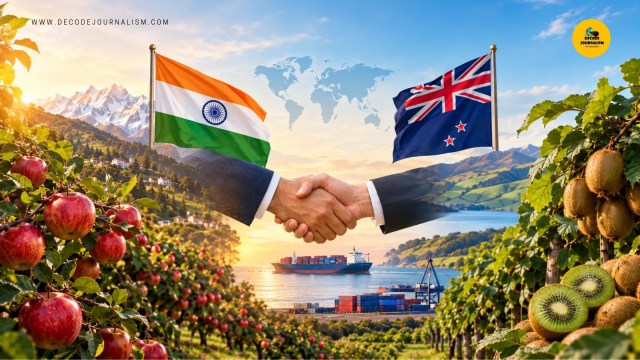
- Will New Zealand apples and kiwis hurt farmers in Himachal and Kashmir?
This is the question people are asking most. Apple growers in Himachal Pradesh and Jammu and Kashmir have seen shaky prices in recent years.
A Free Press Journal editorial notes that New Zealand is the first country to get preferential apple access under any Indian FTA. And Kiwi will enter duty free within a quota. It starts at 6,250 tonnes in year one and reaches 15,000 tonnes by year six. The apple quota size has not been confirmed in the sources reviewed here. The government has paired the quotas with cooperation on agri technology. Goyal said the agreement protects India’s sensitive farm sectors.
However, the All India Kisan Sabha, a farmers’ union, disagrees. It says cheaper imports could hit 1.75 lakh apple farming families.
- Will wine, lamb and manuka honey get cheaper for shoppers?
Yes but at a slow rate. New Zealand’s Trade Minister Todd McClay said Indian wine tariffs of 150% will fall to 25% or 50% over 10 years. Sheep meat and wool are already tariff free.
Before the deal, manuka honey faced a 66% duty. Kiwi fruit faced 33%. No official estimate of shelf prices has been released. Taxes, freight and importer margins also shape what you pay. A lower duty does not always mean a lower price.
- Is dairy protection in the FTA permanent or just postponed?
Dairy was India’s red line. When talks concluded, reports listed milk, cream, whey, yoghurt and cheese among excluded products. Dairy is about 30% of New Zealand’s goods exports.
Goyal addressed the worry. He said New Zealand only sought a chance to discuss dairy if India ever opens that sector to a comparable economy. The Global Trade Research Initiative has called dairy commercially marginal in this deal. Farmer groups see a gap. The Kisan Sabha says duties on some high value dairy items, such as bulk infant formula, are being removed.
Who gains from cheaper New Zealand coal, logs and scrap?
McClay said coal and most forestry products now enter India tariff free. Steel makers use coking coal. Furniture and plywood makers use timber. One report adds metal scrap. However, that claim has not been verified here.
Domestic suppliers of these goods may face more competition. Users of these goods may see lower input costs. Both outcomes are possible.
What changes on 1 January 2027, and onwards?
| When | What changes |
| 20 October 2026 | 57 per cent of New Zealand exports to India tariff free |
| 1 January 2027 | Next round of tariff cuts |
| Over time | Tariff free share rises to 82 per cent |
| Year six | Kiwi quota reaches 15,000 tonnes |
| 10 years | Wine duty falls to 25 or 50 per cent |
| 15 years | Period for the USD 20 billion investment objective |
Does this FTA change the Atmanirbhar debate?
This is the seventh trade pact to come into force in five years. The others are with the UAE, Mauritius, EFTA, the UK, Oman and Australia.
| FTA | In force | Notable detail |
| Mauritius | April 2021 | First of the current wave |
| UAE | May 2022 | Operational for over four years |
| Australia | December 2022 | Covers wine and meat, and India safeguarded dairy |
| EFTA | October 2025 | Switzerland, Iceland, Liechtenstein and Norway |
| Oman | 1 June 2026 | India liberalises 77.79 per cent of tariff lines |
| UK | 15 July 2026 | Duty free access for nearly 99 per cent of Indian exports. UK car tariffs fall from 110 per cent to 10 per cent in phases |
| New Zealand | 20 October 2026 | India liberalises 70.03 per cent of tariff lines |
That raises a fair question. How do openness and self reliance sit together?
The government’s answer is that the two go together. Goyal says the agreement protects India’s sensitive agricultural sectors. The government also ties the deal to its Make in India vision. But critics point to the deficit data. India’s trade deficit with its 23 FTA partners widened to USD 127 billion in 2025, from USD 8.2 billion in 1998. The Free Press Journal editorial noted that the ASEAN FTA inflicted years of industrial pain.
New Zealand is a different case. In FY25, India exported USD 711.1 million to New Zealand and imported USD 587.1 million. Whether that gap holds is a question for the next trade data.
How does this FTA compare with India’s deals with Australia, the UK, the UAE and EFTA?
Dairy protection is the common thread. The India Australia deal of 2022 covers wine and meat but safeguards dairy. Dairy was also protected in the India UK deal.
Speed is different. Talks here began in March 2025 and ended in nine months. McClay called that a record for India on a comprehensive trade agreement. Earlier talks ran from 2010 and stalled in 2015.
How does the FTA shape India’s stance in talks with other partners?
A pattern is visible. India offered quotas, price floors and seasonal windows on its sensitive farm lines. It protected the sectors it calls most vulnerable and asked for talent mobility in return. Bigger partners are watching. India concluded an FTA with the European Union in January 2026. A trade compliance tracker lists 2027 for its entry into force. India has also been preparing to re engage with the United States on a separate interim trade agreement. Talks continue on a deal with Chile.
None of those partners has the same farm profile as New Zealand. Still, how India treated apples and dairy here shows its negotiating habits.
Gulzar Didwania, Partner at Deloitte India, said the deal should support higher FDI. He added that the scale depends on private firms. However, the USD 20 billion figure is an objective over 15 years. It is not a guarantee.
Conclusion
The India-New Zealand Free Trade Agreement is a big step for India’s trade diplomacy. It opens new doors for economic cooperation. Indian goods get better access to the New Zealand market, and there are new opportunities in services, travel for work and study, and cooperation in farming, investment and newer sectors. The benefits should reach many people. Farmers, small businesses, students and skilled professionals could all gain from the deal. It also helps India build its reputation as a reliable and forward-looking global partner, in line with the goal of a globally integrated Viksit Bharat by 2047.