
Pakistani drones are still slipping past India’s border defences and dropping drugs into Punjab. In 2024 alone, the Border Security Force brought down or recovered 294 drones along the Punjab border, up from 107 in 2023. Most of these unmanned aircraft came loaded with heroin, weapons or cash, and many landed safely despite a costly wall of fencing, sensors and jammers.
This trend matters because it shows that physical barriers and even high tech counter drone systems are struggling to keep pace with cheap, fast moving aerial smuggling. Punjab’s drug crisis has spread into neighbouring Haryana and Himachal Pradesh, and officials admit that Pakistani drones remain central to the supply chain.
How big is the Pakistani drones problem right now?
The numbers tell their own story. According to the Border Security Force, drone interceptions in Punjab have climbed sharply over four years.
| Year | Drones intercepted in Punjab | Heroin recovered |
| 2021 | 67 | Not specified |
| 2022 | 254 | 280 kg |
| 2023 | 107 | Not specified |
| 2024 | 245 | 254 kg |
| 2025 (till Nov 30) | 272 | 367 kg |
Source: BSF Punjab Frontier data, The Tribune, News on Air
The Border Security Force said it seized close to 283 kilograms of narcotics along the Punjab border last year while bringing down these drones. Most of the aircraft are Chinese made DJI Mavic or Matrice quadcopters. They usually carry a single packet of heroin weighing 450 to 550 grams, wrapped in yellow tape, along with pistol parts or ammunition in some cases.
The Narcotics Control Bureau’s own numbers back this up. The agency recorded 163 cases of drone based drug smuggling in Punjab in 2024, compared with just three cases in 2021. Heroin accounted for 187 kilograms of the drugs recovered through this route that year.
Tarn Taran and Amritsar districts remain the biggest hotspots. Officials say the terrain here, with dense sugarcane fields and villages close to the fence, makes it easier for drones to drop packets unnoticed.
Why are Starlink links a menace for the Indian government?
Satellite internet is changing how smugglers operate, and Indian security agencies are watching closely.
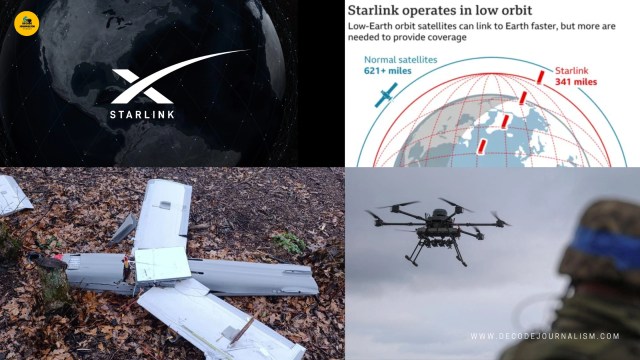
Until recently, most smuggling drones relied on radio frequency links between the aircraft and a ground controller. This made them vulnerable to jamming, since security forces could block the signal and force the drone down. Officials in Punjab told Business Standard that newer drones are increasingly built with satellite linked navigation, which reduces dependence on jammable radio frequency control.
This is not just a Punjab problem. In November 2024, Indian police seized a large consignment of methamphetamine near the Andaman and Nicobar Islands from a vessel that was steered remotely using a Starlink terminal, one of the first such cases reported anywhere in the world. Drug cartels in Colombia have since used the same approach with unmanned semi submersible boats fitted with Starlink antennas.
For Indian security planners, the concern is straightforward. If cross border drones start using satellite links instead of local radio signals, existing jammers built to disrupt radio frequency communication become far less effective. A drone that does not need a nearby ground controller is much harder to trace back to its operator.
There is no official confirmation yet that Starlink linked drones are being used on the Punjab border specifically. But the direction of the technology, and its use elsewhere in narcotics smuggling, has made it a serious point of worry for agencies planning India’s next generation anti drone systems.
Why are expensive anti-drone systems failing to control the drug trafficking situation?
Punjab has spent heavily on technology to stop this menace, yet drones keep getting through. The state’s flagship response is the Baaz Akh, or Hawk Eye, anti drone system.
What is the Baaz Akh anti-drone system?
Baaz Akh is Punjab’s own drone defence grid, launched by Chief Minister Bhagwant Mann and AAP leader Arvind Kejriwal on August 9, last year in Tarn Taran. It made Punjab the first Indian state to deploy its own anti drone network along an international border, working as a second line of defence behind the BSF. Despite this investment, officials concede that the system has clear limits.
| Feature | Detail |
|---|---|
| Launch date | August 9, 2025 |
| Cost | Rs 51.4 crore |
| Detection and jamming range | 8 to 10 km |
| Units installed initially | 3, with 6 more planned |
| Coverage | Pathankot to Fazilka, 532 km border |
| Coordination | Punjab Police, BSF, Army and Air Force |
Why does Baaz Akh still fall short?
- Fail safe return to home. Newer Pakistani drones are programmed to detect jamming and automatically fly back across the border before they can be seized. A senior Punjab Police officer told Business Standard that this back to home feature means many drones escape even when interference is applied successfully.
- Satellite linked navigation. As explained above, drones that rely less on radio frequency control are naturally more resistant to jamming, cutting into one of Baaz Akh’s core functions.
- Coverage gap. Officials say Punjab needs at least 100 jamming units for effective, wider coverage of the border. With only a handful of units operational so far, most of the 532 kilometre stretch remains only partially covered.
The same police officer said the detection rate itself is high, sometimes touching eight to fifteen drones a day, but detection alone does not guarantee recovery of the drone or the drugs it carries.
Why is drug addiction spreading in Haryana and Himachal Pradesh?
Punjab’s drone problem is no longer contained within the state. Both Haryana and Himachal Pradesh, which border Punjab, are reporting a sharp rise in drug addiction cases.
In Haryana, the state government told the assembly that 52,207 youths sought treatment at de-addiction centres between April 2024 and March 2025, compared with 11,395 in 2020-21. Panchkula, Ambala and Sirsa districts, all close to the Punjab border, recorded the highest numbers.
Himachal Pradesh has seen a similar pattern. Police data shows 597 cases were registered under the Narcotic Drugs and Psychotropic Substances Act in just the first three months of 2025, a 29 percent rise over the same period in 2024. Heroin, known locally as chitta, accounted for more than 305 of these seizures. The state recorded 31 drug overdose deaths in 2024, up from 8 in 2023.
Health officials in both states link the trend to Punjab’s proximity and its role as an entry point for Pakistani supplied heroin. Once drugs cross the border by drone, distribution networks move the consignments further into neighbouring states through road transport, often within hours.

How are gangsters running this business while sitting in jails?
One of the more troubling parts of this story is how little a jail term seems to stop the trade. Investigations by Punjab Police have repeatedly found that gangsters and drug smugglers continue to run their networks from inside prison, using smuggled mobile phones.
In one case reported by the Tribune, a drug peddler arrested with a kilogram of heroin told police he was acting on instructions from an inmate at Amritsar Central Jail, who was already serving a sentence for murder. Jail authorities in Amritsar alone have recovered dozens of mobile phones hidden inside the prison over the years.
The problem has grown wider. Punjab government teams recovered 710 mobile phones from prisons during a special drive between March and May in one recent year, according to state officials. In Sangrur, police uncovered a racket in which four kilograms of heroin and a pistol were being managed from inside the district jail. In Patiala this year, police arrested men who had thrown contraband packets over jail walls dozens of times.
Jail officials say some inmates use tiny two to three inch phones known locally as kachoda phones, which are difficult to detect and can hold multiple SIM cards. In July 2024, authorities moved 200 high risk inmates to Bathinda Central Jail, which has jammers to block mobile signals. However, several other prisons in the state still lack this infrastructure, leaving a gap that gangsters continue to exploit.
Are new fences the answer, or is money being wasted?
The Centre and Punjab government have both invested heavily in physical border infrastructure over the years. The Border Security Force has been reconstructing sections of the anti infiltration fence with a stronger design, and India has tested new steel fencing along stretches of the Pakistan and Bangladesh borders.
Critics, including some Punjab farmers and local leaders, argue that fresh spending on fencing infrastructure does little to stop a threat that flies over the wire entirely. Drones do not need a gap in the fence, they simply go around it at a height the barrier cannot reach. This is why officials increasingly describe anti drone technology, not fencing, as the real second line of defence.
The Punjab government’s own budget reflects this shift. In its 2025-26 budget, the state earmarked Rs 110 crore for anti drone systems and home guards along the border, separate from earlier fencing related spending. Finance Minister Harpal Cheema said the state would deploy the most advanced anti drone technology available anywhere in the world.
Why is drug smuggling still active despite Gujarat port seizures?
Punjab’s land border is not the only route drugs take into India. Gujarat’s ports, particularly Mundra, have become a major entry point for large consignments arriving by sea, often originating from Afghanistan or Iran through international shipping routes.
According to the 2025 Narcotics Control Bureau annual report, coastal states including Gujarat, Maharashtra, Kerala and Tamil Nadu have emerged as hotspots for synthetic drug smuggling, with maritime seizures rising nearly 500 fold since 2019. In one of the largest hauls on record, the NCB intercepted around 80 tonnes of heroin near Mundra port in 2024, valued at roughly Rs 2,400 crore.
Investigators say the pattern typically involves large shipments landing at Gujarat ports hidden inside containers of legitimate cargo, such as talc powder or semi precious stones. From there, smaller consignments are broken down and transported by road, often passing through Rajasthan and Delhi before reaching Punjab, where established distribution networks take over. In one high profile case, a seizure of nearly 3,000 kilograms of heroin at Mundra port in 2021 was traced back through a chain that investigators say Punjab Police intelligence had helped uncover, showing how closely the western maritime route and the Punjab drone route are now linked in the trade.
The National Investigation Agency has conducted raids across the Delhi National Capital Region in connection with Mundra port drug cases, indicating that the network extends well beyond any single state.
Why did drug smuggling not stop even after giving BSF a 50 km area in Punjab?
In 2021, the Union Home Ministry expanded the BSF’s operational jurisdiction in Punjab from 15 kilometres to 50 kilometres from the international border, a move the government said was necessary because drones could carry payloads well beyond the fence. Officials at the time argued that smugglers were taking advantage of the earlier 15 kilometre limit by operating just outside BSF’s reach.
The Punjab government strongly opposed the decision, calling it an attack on federalism, since law and order is a state subject under India’s Constitution. The state government even moved the Supreme Court against the notification.
Four years on, the expanded jurisdiction has not stopped the flow of drugs. Legal experts point out that while the BSF’s area of operation grew, its investigative powers did not expand in the same way. The force can arrest, search and seize within the 50 kilometre belt, but any case still has to be handed over to Punjab Police for investigation and prosecution. This has created what legal commentators describe as a jurisdictional gap, where enforcement authority and investigative capacity do not fully align.
Meanwhile, the core problem remains unchanged. Drones still cross the fence regardless of which force is technically responsible for the ground beyond it, and the smuggling networks on both sides of the border have adapted quickly to each new countermeasure.
What happens next?
Punjab Police has said it will add six more Baaz Akh units to cover the length of the border from Pathankot to Fazilka, and officials continue to test additional systems from private defence companies, including Adani Defence and Aerospace, which demonstrated its own counter drone technology in Tarn Taran in 2025. The state’s 2025-26 budget allocation of Rs 110 crore signals that spending on this front will only grow.
At the same time, the National Investigation Agency and Narcotics Control Bureau are widening their probes into the Gujarat port route, suggesting a more coordinated national approach linking Punjab’s land border with maritime smuggling networks. Whether these efforts can outpace the technology being used by smugglers, including satellite linked drones, will determine how the next phase of this fight plays out along India’s border with Pakistan.