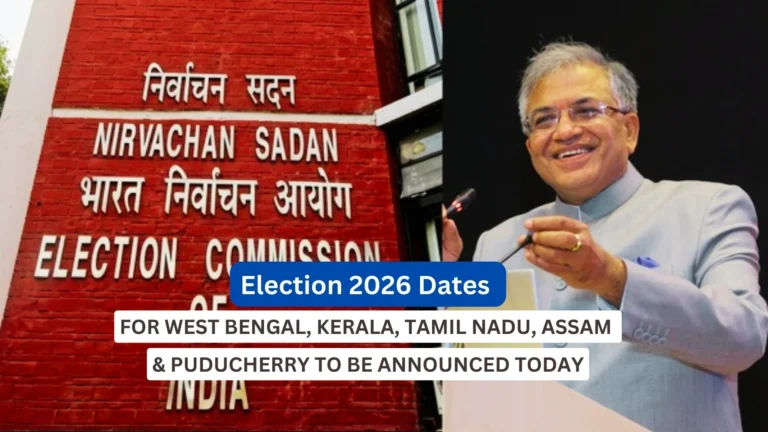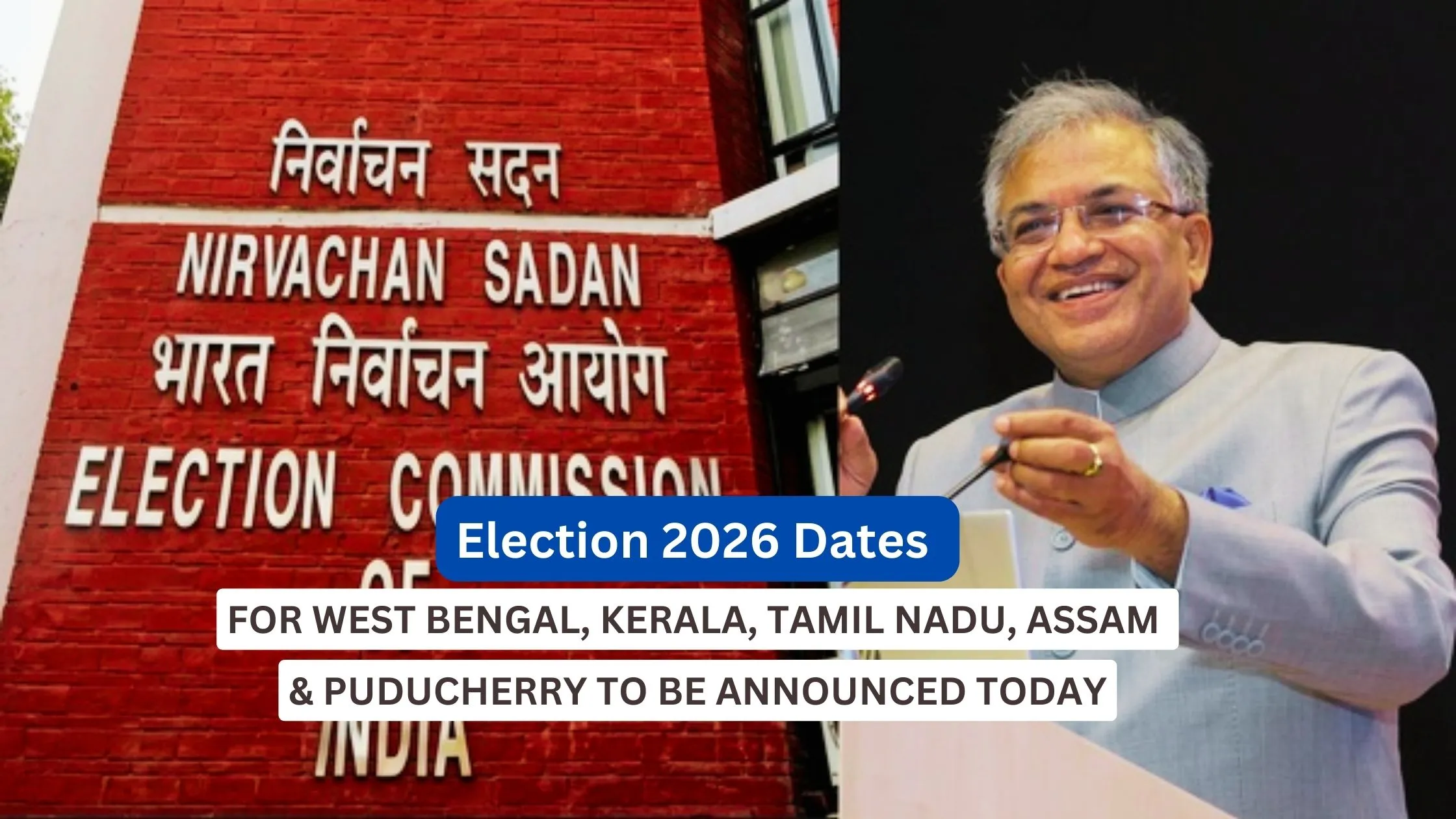
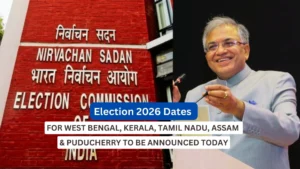
Election 2026 dates are coming up for West Bengal, Kerala, Tamil Nadu, Assam, and Puducherry. The Election Commission of India (ECI) will announce dates via a press conference at 4 pm today, for assembly polls in the above-mentioned five states. According to sources in the Election Commission, it is indicated that the upcoming elections will likely involve fewer phases than in 2021, when West Bengal went to polls over eight phases, Assam over three, and Tamil Nadu, Kerala, and Puducherry in a single phase. This time elections 2026 are likely to be held in a single phase in all states, except Bengal, which makes headlines for political violence in every election.
The terms of these legislative assemblies are ending in May and June. For instance, the West Bengal assembly’s term gets over on May 7, Tamil Nadu’s on May 10, Assam’s on May 20, Kerala’s on May 23, and Puducherry’s on June 15.
The moment the schedule is announced, the Model Code of Conduct kicks in automatically, putting a freeze on new government schemes, state-funded publicity, and freebies designed to woo voters. Polling is widely expected in April, with results likely in early May, before the assemblies’ constitutional terms expire.
1. WEST BENGAL: Mamata’s Fourth Gamble, BJP’s Unfinished War
Mamata Banerjee has won three consecutive elections in West Bengal. That is not a small thing. Now she wants a fourth term, which would make her arguably the most electorally dominant regional leader in India.
In 2021, her TMC won 213 out of 294 seats. The BJP which had carpet-bombed the state with central ministers as candidates, spent enormous money, and ran some of the most aggressive campaigns but managed 77 seats only. And yet, here is the uncomfortable truth for Mamata going into 2026: she has more enemies now than she did in 2021, and some of them used to be her friends.
The real question in Bengal is simple: is welfare scheme loyalty stronger than accumulated public anger? Bengal 2026 will answer that.
2. Tamil Nadu: Stalin Holds, Vijay Disrupts, AIADMK’s Identity Crisis
Tamil Nadu has been among the most resistant states to BJP’s political model, and that has not changed. The DMK-led alliance which includes Congress won 159 seats. However, the AIADMK-BJP alliance won 75 where BJP alone managed 4 seats in the state.
Political analysts are not treating Vijay as a winner. They are treating him as a wildcard who could decide who wins, without winning himself. The AIADMK, meanwhile, is a party in genuine identity crisis. After Jayalalithaa’s death in 2016, the party went under a leadership war and also broke its alliance with BJP ahead of elections 2026.
Without its founding personality, whether the divided party can credibly position itself as the principal opposition or not, is Tamil Nadu’s second biggest question.
3. Kerala: Can the Left Actually Break 44 Years of Political Rotation?
Since 1982, Kerala had unfailingly alternated between the LDF and Congress-led UDF every five years. But in 2021, Pinarayi Vijayan’s LDF broke the pattern and won 99 of 140 seats, hence claiming his consecutive second term. The BJP won zero seats despite making gains in vote share. Now at 80, he is trying for a third. Nobody in Kerala’s political history has done this.
The Congress-led UDF is simply hoping that voters are tired of the Left — and that enough scandals have piled up to give people a reason to switch. The BJP is not really expecting to win Kerala; it just wants a few seats on the board. Even 5 or 6 seats would let them say they finally have a foot in the door of a state that has historically shown them the exit.
4. Assam: Himanta’s Bulldozer Politics and Its Discontents
The BJP-led alliance won 75 of 126 seats in 2021 and has been running the show since. Himanta Biswa Sarma became Chief Minister and has been governing in a way that you simply cannot ignore. He has torn down illegal encroachments, gone hard on drugs and child marriage, and made illegal immigration the centrepiece of his political identity. Love him or hate him, the man knows how to stay in the news.
But here is where it gets uncomfortable. Human rights groups and opposition parties have consistently alleged that his demolition drives hit Bengali Muslim communities the hardest, often without proper legal notice or due process. Himanta calls it necessary governance. His critics call it targeted harassment dressed up as law enforcement.
The opposition is in a worse position than it was in 2021. Congress and AIUDF, who were on the same team last time, are likely to contest separately this time around. This is basically a free gift to the BJP — because when two opposition parties are fighting for the same votes in the same areas, they end up splitting that vote right down the middle, and BJP walks through the gap.
5. Puducherry: Small State, Large Constitutional Mess
Puducherry has just 30 assembly seats, which makes it the smallest battleground on this list — but do not let the size fool you.
The current AINRC-BJP alliance holds exactly 16 seats, a one-seat majority that is as fragile as it sounds. They have somehow held it together, but governing with that kind of margin is less like running a state and more like defusing a bomb every other week.
The deeper problem in Puducherry is structural. Because it is a Union Territory and not a full state, the elected Chief Minister always has to share power, often awkwardly, with a centrally-appointed Lieutenant Governor. This has caused very public friction across governments of all political colours. It is essentially a setup where even if you win the election, you do not fully control the wheel. Congress, allied with DMK this time, is hoping to come back. BJP just wants to hold what it has and call it a symbolic southern win.
More News



About the Author