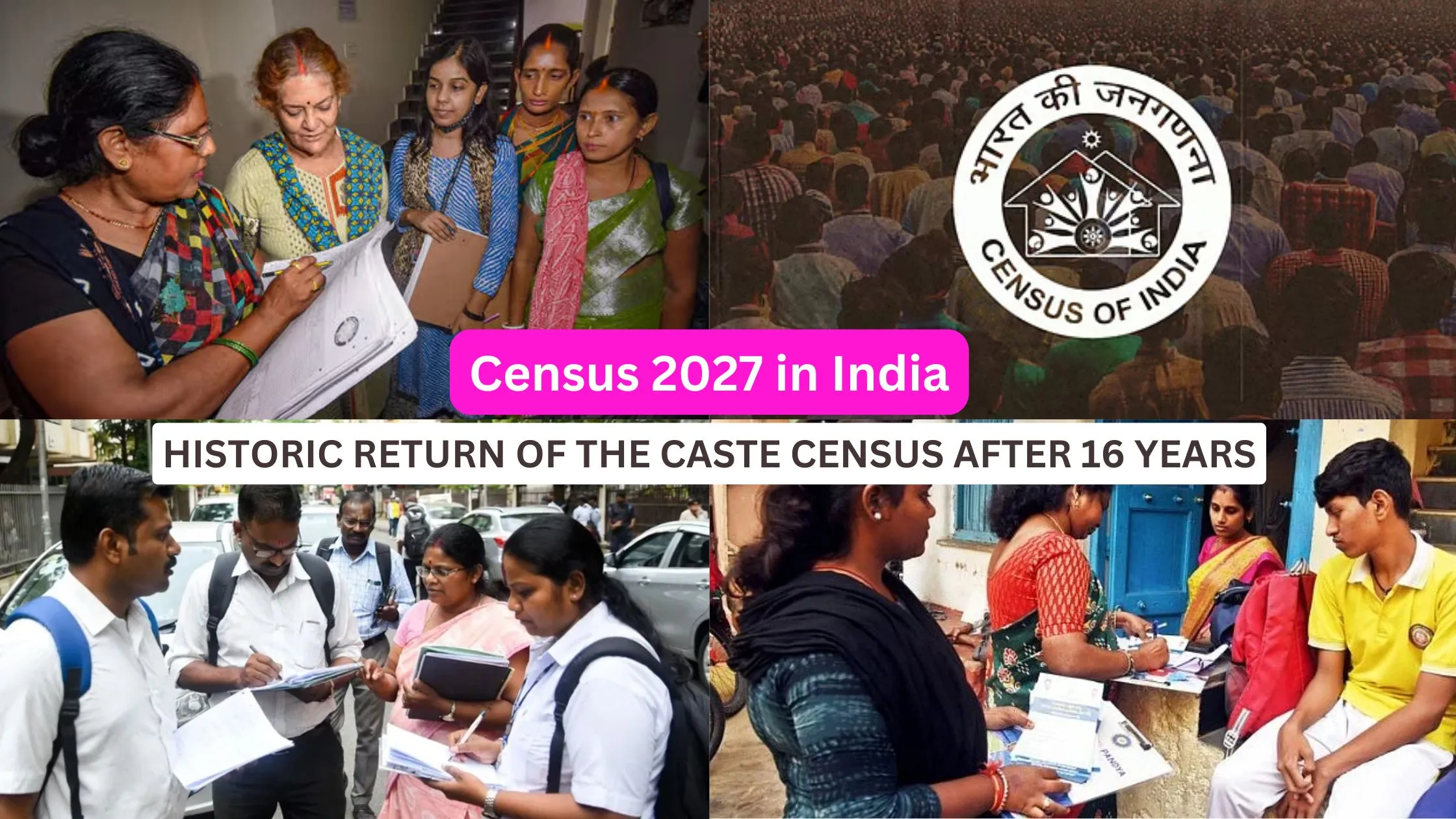
The long-awaited population census 2026, which is set to start on April 1 after a delay of more than five years, received ₹6,000 crore from the Union budget on Sunday. In the previous year’s budget, the budgetary allotment for the RGI and the Census exercise was originally Rs 574.80 crore, but it was later changed to Rs 1,040 crore.
For more than 150 years, India had never missed its decadal census appointment until 2021. Due to a massive 16-year data vacuum caused by the 2019 pandemic-induced delay, the upcoming Census 2026-27 will be much more than just a standard headcount. It is a basic “reboot” of the country’s statistical identity.
Last year, the Union government announced the 16th Census, which will include caste enumeration. It is anticipated to be finished by March 1, 2027, and will be carried out in two stages. The first phase of the population count, which will include the first caste enumeration, will take place between April 1 and September 30, 2026, and the second phase will take place in February 2027. There haven’t been any population counts since 2011, despite the fact that they should occur every ten years.

In the first phase, HLO (houselisting operation), housing conditions, assets and amenities of each household will be collected from April 1, 2026. Subsequently, in the second phase or PE (population enumeration) will be collected from February 1, 2027. Every individual in every household will have their demographic, socioeconomic, cultural, and other information gathered during the PE.
Beginning on April 1, 2026, each household’s assets, amenities, housing conditions, and HLO (houselisting operation) will be gathered. Subsequently, in the second phase aka PE (Population enumeration) will then be gathered starting on February 1, 2027. During the PE, every person in every household will have their demographic, socioeconomic, cultural, and other data collected.
Census 2026: What types of questions will be asked in Phase 1?
People will be asked 33 questions in the first phase of the census, according to the Registrar General’s announcement. These include whether a family owns a car, jeep, van, bicycle, scooter, motorcycle, smartphone, Internet connection, or phone.
Cereals consumed at home, the primary sources of lighting and drinking water, the type and accessibility of toilets, waste-water outlets, bathing facilities, the availability of kitchen and LPG/PNG connections, the primary fuel used for cooking, and the presence of a radio, transistor, or television are all questions that will be asked.
Additionally, they will be questioned about the materials that were primarily used to construct their home’s floor, walls, and roof; the state of the house; the number of household members; whether the head of the household is a woman, Scheduled Caste, or Scheduled Tribe; the number of dwelling rooms that are solely owned by the household; and the number of married couple(s) living there.
3.2 million Census functionaries to undergo training for first phase
Approximately 32 lakh enumerators—mostly supervisors and teachers—as well as 1.3 lakh census workers will use mobile phones to collect the data. These employees will receive training on how to approach people, make inquiries, establish rapport, ensure absolute data confidentiality, behave impartially, and be sensitive when speaking with the public, especially when it comes to private matters.
According to the circular, training sessions will focus on the exercise’s fundamental ideas, and all training materials are now available in 16 languages.
The actual data collection for Census 2026-27 will be carried out by 100 national trainers (NTs) from DCOs, 2,000 master trainers (MTs) made up of DCOs and officers nominated by states, 45,000 field trainers (FTs) sourced from states, and three million enumerators and supervisors.
“The training curriculum for Census 2027 is designed to be comprehensive, practical, and fully adapted to the new digital environment. The philosophy extends beyond merely explaining what data to collect; it places significant emphasis on how to collect it accurately, efficiently, and with the required sensitivity to make the data collection humane,” the circular added.
Gujarat govt notifies houselisting schedule for Census 2026
On February 2, 2026, the General Administration Department (Planning) republished the notice in the Gujarat Government Gazette. According to this notification, in Gujarat, the houselisting process will take place between April 20 and May 19, 2026.
The 30-day house-to-house houselisting exercise will begin immediately after a 15-day period of self-enumeration.
Massive budget allocation to police infrastructure
The budgetary allotment for the infrastructure of the Delhi Police, Central Armed Police Forces (CAPF), and Central Police Organizations has increased by almost 50% as compared to the estimates from the previous year’s budget.

Under these categories, a total of Rs 5,394 crore has been allotted for infrastructure projects, up from Rs 3,684 crore in the previous year’s revised Budget. Additionally, Delhi Police’s budgetary allotment for infrastructure projects has increased by almost 50%, from Rs 162.51 crore for this fiscal year to Rs 342.50 crore based on the revised estimates of the 2025-26.
The 2026-27 census is a constitutional moment rather than merely a statistical requirement. It will determine whether your neighbor receives the welfare benefits they are entitled to, how many seats your state receives in Parliament, and how your taxes are allocated. After 16 years of waiting, India is finally getting a mirror that reflects its true, modern face.
About the Author