
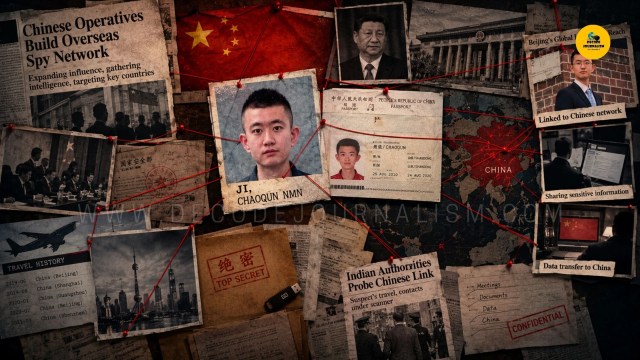
A Chinese national who came to Chicago as a student was sentenced to eight years in a US federal prison for acting as a spy for the Chinese government. The sentence was handed down in Chicago by US District Judge Ronald A. Guzman. Ji Chaoqun, 31, had been convicted a year earlier of working as an unregistered agent of the People’s Republic of China. His case shows how a spy network can quietly build inside a university campus and later reach into the US military.
The case matters because it involves a foreign spy operation aimed at American defence and technology workers. It also raises questions about how easily a recruitment program meant to help the US military can be misused.
Who Is Ji Chaoqun And What Did He Do As A Spy?

Ji Chaoqun arrived in Chicago in 2013 on a student visa. He enrolled at the Illinois Institute of Technology to study electrical engineering. He was, by most accounts, an ordinary international student.
According to the US Department of Justice, Ji was later tasked by Xu Yanjun, a deputy division director in China’s Ministry of State Security, with a clear job. He had to collect background information on people who could be recruited as spies for Beijing. Officials said the targets included Chinese nationals working as engineers and scientists in the United States, some employed by American defence contractors.
In 2016, Ji enlisted in the US Army Reserve. He joined through the Military Accession Vital to the National Interest program. This program allows the armed forces to recruit foreign nationals whose skills are considered valuable. In his application, Ji falsely stated that he had not had any contact with a foreign government in the past seven years, according to the Justice Department.
When Was The Spy Case Filed And How Did The FBI Catch Him?
Ji was arrested in September 2018. Investigators say he had several meetings that year with an undercover agent posing as a Chinese intelligence contact. Those conversations were recorded.
During the meetings, Ji reportedly said his military identification could let him photograph aircraft carriers. He also said he hoped to later seek work at agencies like the CIA, FBI or NASA once he secured citizenship and a security clearance through the reserve program.
A federal jury in Chicago convicted Ji in September 2022 on three counts. These included conspiracy to act as a foreign agent, acting as an agent of China without notifying the Attorney General, and making a false statement to the US Army. He was sentenced in January 2023.
Why Did Beijing Target US Engineers And Scientists?
Prosecutors said the operation was part of a wider effort by the Jiangsu provincial unit of China’s Ministry of State Security. The goal was to gain access to advanced aerospace and satellite technology being developed by American companies. Ji reportedly used commercial background check sites to build detailed profiles on potential recruits and sent the reports to his handler.
His handler, Xu Yanjun, was later arrested in Belgium and extradited to the United States. Xu was convicted of economic espionage and attempted theft of trade secrets tied to a separate scheme targeting an Ohio aviation company. He was sentenced to 20 years in prison in November 2022, a much longer term than the one given to Ji.
The gap between the two sentences reflects the different roles each man played. Xu directed the operation as a serving intelligence officer. Ji acted as a recruited agent on the ground.
What Does This Spy Case Mean For US Security Policy?
The case has renewed scrutiny of programs that allow foreign nationals to enlist in the US military in exchange for a path to citizenship. Congress had already reviewed the MAVNI program in earlier years over similar vetting concerns.
The Department of Justice has treated Ji’s conviction as part of a broader pattern. US officials have repeatedly said that Chinese intelligence services try to identify insiders at American universities, defence contractors and research institutions.
Legal experts note that the charge used against Ji, acting as an unregistered foreign agent, is often applied when prosecutors cannot clearly prove someone is a formal spy but can show they knowingly worked for a foreign government’s interests. This is different from a straightforward espionage charge and generally carries a lighter sentence.
Related Developments
Xu Yanjun’s case remains one of the rare instances in which a Chinese government intelligence officer was extradited to and tried in a US court. His sentencing in Cincinnati was seen as a signal from federal prosecutors that similar recruitment schemes would be pursued aggressively.
The Justice Department has continued to bring similar cases involving alleged Chinese state efforts to recruit US based engineers and scientists, particularly those with backgrounds tied to defence and aerospace work. Ji’s case remains a reference point in discussions about how such recruitment schemes are identified and prosecuted.
This article is based on official statements from the US Department of Justice, court records from the Northern District of Illinois and the Southern District of Ohio, and reporting from CNN, NBC News and VOA News.