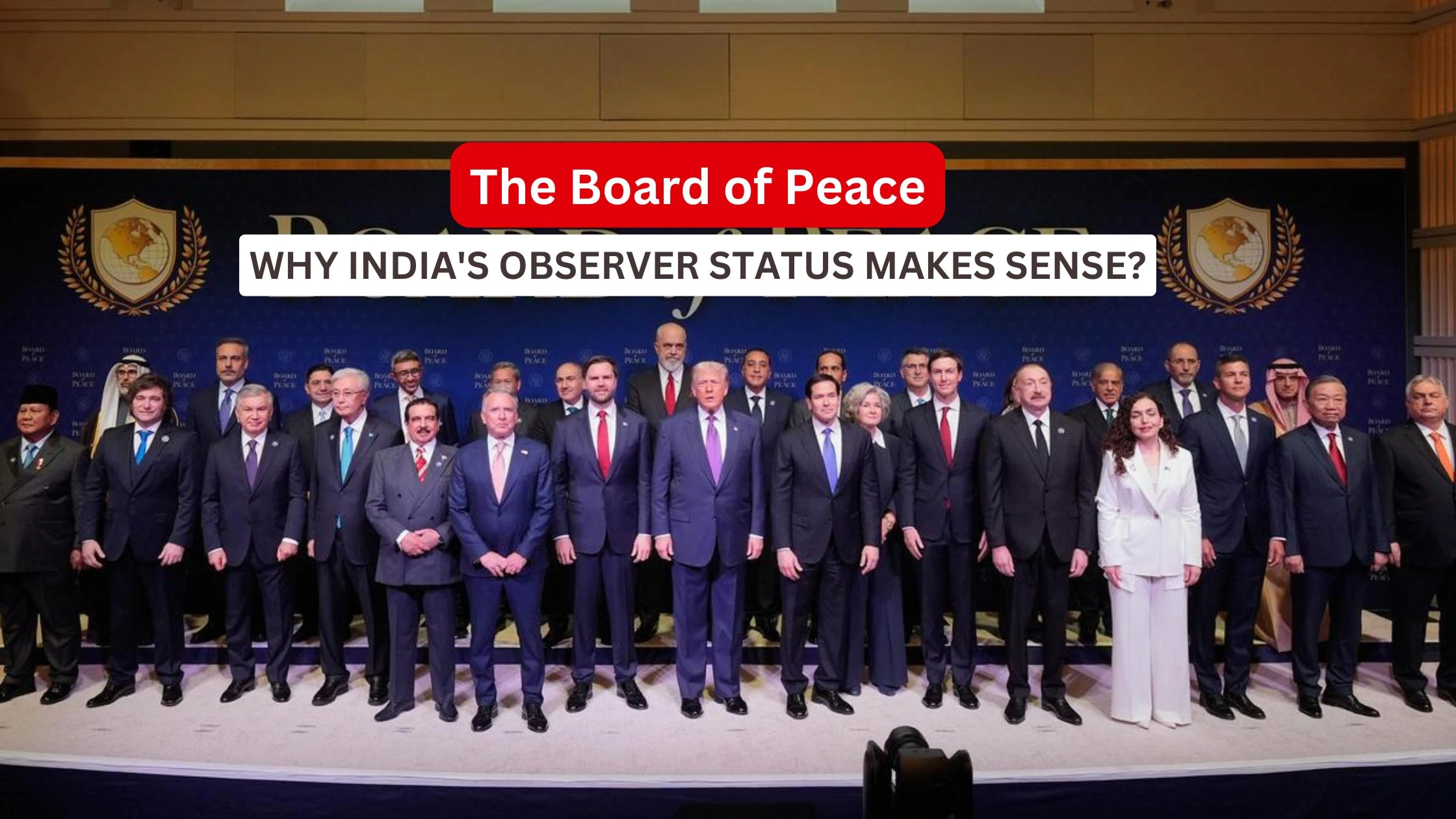
India quietly attended President Donald Trump’s Board of Peace first meeting on February 19 as an observer country, represented by Namgya C Khampa, the Charge d’Affaires at the Indian Embassy in Washington DC. This came just a week after the Ministry of External Affairs said it was “reviewing” the US invitation—a diplomatic way of saying they weren’t sure this was a good idea.
And honestly? We might have been right to hesitate.
What is the Board of Peace?
Trump unveiled the Board of Peace at the World Economic Forum in Davos last month with his characteristic flair. Initially pitched as an organization to oversee the Israel-Hamas ceasefire in Gaza and manage reconstruction and governance of the strip, Trump declared that “everyone wants to be a part” of this new body—which, he suggested, could eventually rival the United Nations.
Who signed the charter for the Board of Peace?
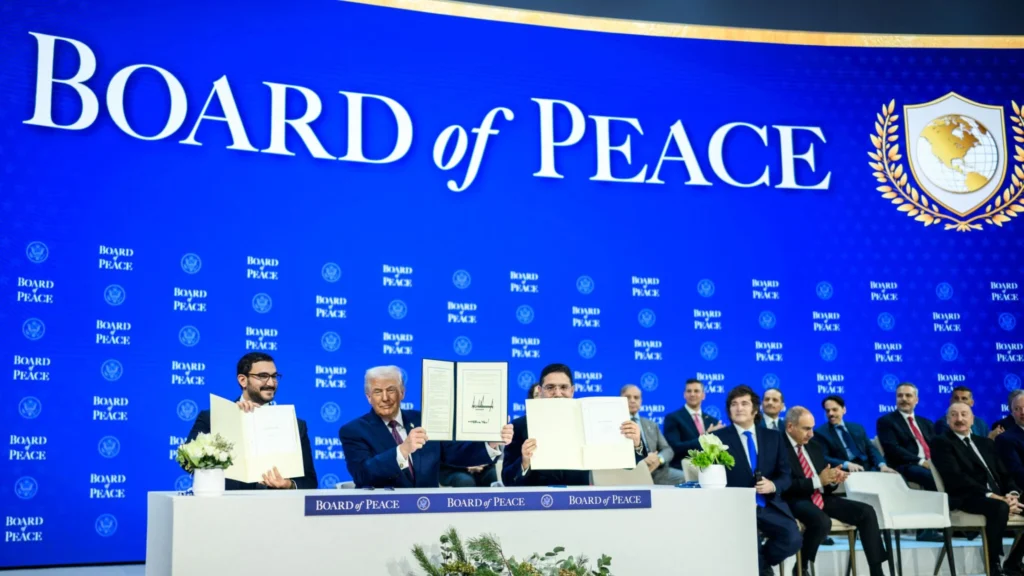
On January 22, 2026, Trump formally ratified the Charter of the Board of Peace in Davos, Switzerland, establishing it as what he calls an “official international organization.”
Is the Board Replacing the Security Council?
The UN Security Council derives its authority from the UN Charter, a treaty ratified by member states that explicitly assigns it primary responsibility for maintaining international peace and security. That mandate was conferred collectively by the international community through a carefully negotiated process spanning years. It’s not something you can just replicate by declaring a new organization into existence at a Swiss resort.
Under Article 25 of the UN Charter, UN member states are legally obligated to carry out Security Council decisions.
The Board of Peace? It has no comparable mechanism. Its decisions apply only to states that choose to participate and carry zero legal force for non-members. In other words, it’s a voluntary club, not a governing body.
Only the Security Council possesses Chapter VII powers—the authority to impose sanctions and authorize the use of force in ways recognized across jurisdictions worldwide. The Board of Peace can coordinate political positions and pool financial resources, but it cannot create enforcement regimes that bind the international system as a whole.
How many countries participated in the Board of Peace meeting?
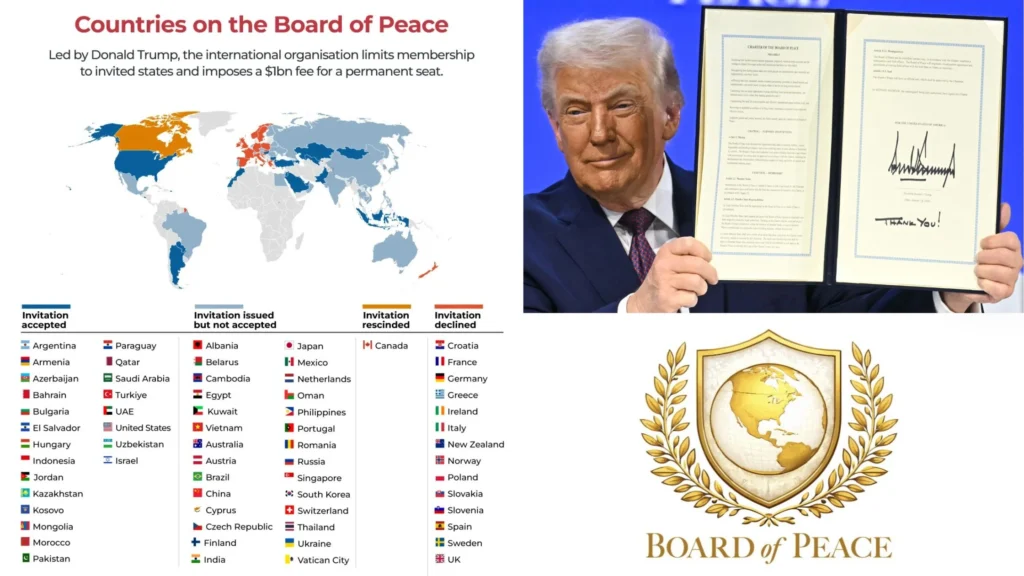
Officials from nearly 50 countries participated in the meeting at the US Institute of Peace in Washington. Of these, 27 countries formally joined the board, including Azerbaijan, Belarus, Egypt, Hungary, Indonesia, Israel, Jordan, Morocco, Pakistan, Qatar, Saudi Arabia, Turkey, the UAE, Uzbekistan, and Vietnam.
The rest, including India and the European Union, participated as observers—a diplomatic middle ground that lets them stay informed without fully committing. It’s worth noting which major powers are conspicuously absent from the full membership list. The cautious approach from democracies like India and the EU speaks volumes about the credibility concerns surrounding this initiative.
Outcomes: What happened in the first meeting of the Board of Peace?
The central agenda was the proposed International Stabilisation Force, designed to maintain security and implement a transitional governance plan in Gaza. This is where the Board of Peace moves from abstract concept to concrete—and controversial—action.
Trump announced that nine members—Kazakhstan, Azerbaijan, UAE, Morocco, Bahrain, Qatar, Saudi Arabia, Uzbekistan and Kuwait—have pledged a combined $7 billion toward a relief package for Gaza. He also announced that the US is pledging $10 billion for the Board of Peace, though notably, he didn’t specify what this money would actually be spent on.
Major General Jasper Jeffers, commander of the international security force, announced that Morocco, Kazakhstan, Kosovo and Albania have pledged to send 20,000 troops to Gaza. Egypt and Jordan will train personnel. Indonesia, pledging 8,000 troops, will serve as deputy commander of the force.
Turkey’s Foreign Minister Hakan Fidan said Ankara is ready to commit troops and contribute to rehabilitation of health and education sectors, as well as training of police forces. “We can also contribute meaningfully to the rehabilitation of health and education sectors as well as the training of the police force. In addition, we are prepared to provide troops to the International Stabilization Force,” he said.
The board also plans to build 100,000 homes in Rafah with $5 billion dedicated to infrastructure, eventually expanding to 400,000 homes total. That’s an ambitious construction program in an active conflict zone being coordinated by a brand-new international body with no track record.
The Questions Nobody’s Asking
- Where’s the accountability? When you’re deploying troops and spending billions in reconstruction funds, oversight matters. Who audits the spending? Who investigates allegations of misconduct? Who ensures the money actually reaches civilians in Gaza rather than disappearing into administrative overhead or contractor profits?
- What about Palestinian self-determination? The Board of Peace plans to play a role in Gaza’s governance and rebuild 400,000 homes. But who’s consulting the Palestinian people about what they want their future to look like? Or is this another case of powerful countries deciding what’s best for others without meaningful input from those most affected?
- Why the rush? Legitimate international institutions take years to negotiate, establish, and operationalize. The Board of Peace went from concept to operational deployment in weeks. That’s either remarkably efficient or dangerously hasty—and given the complexity of what it’s attempting, probably the latter.
Skepticism isn’t cynicism—it’s due diligence!
Trump launched this initiative with characteristic confidence. But confidence doesn’t rebuild homes, doesn’t establish legitimate governance, and doesn’t create sustainable peace. Only careful, accountable, inclusive work does that.
But the Board of Peace faces a fundamental credibility test: can it deliver meaningful results in Gaza while maintaining genuine multilateral character, or will it become another vehicle for great power politics dressed in humanitarian language? The answer will determine whether this is remembered as an innovative response to international gridlock or as a cautionary tale about the dangers of improvising global governance.
So for now, India’s cautious observer status seems appropriate. When an organization goes from announcement to troop deployment in under a month, skepticism isn’t cynicism—it’s due diligence.
The world is watching. So are the people of Gaza.The Board of Peace has made its promises. Now comes the hard part: keeping them.
More News


About the Author