The political landscape of West Bengal was set ablaze today as the Enforcement Directorate (ED) launched coordinated raids on the residence of Pratik Jain, co-founder and director of the high-profile political consultancy firm I-PAC, and the firm’s Salt Lake office.
The situation turned into a full-blown constitutional standoff when Chief Minister Mamata Banerjee personally arrived at Jain’s Loudon Street residence, accusing the central agency of being a tool for “political espionage.”
Why ED Raids I-PAC Chief’s Residence: What Happened?
Starting at approximately 6:00 AM, a special ED team—reportedly arriving from Delhi—began search operations at 10 locations across Kolkata and Delhi. The probe is officially linked to a money laundering investigation involving an alleged coal smuggling scam, though some reports suggest ties to a fake government job racket.
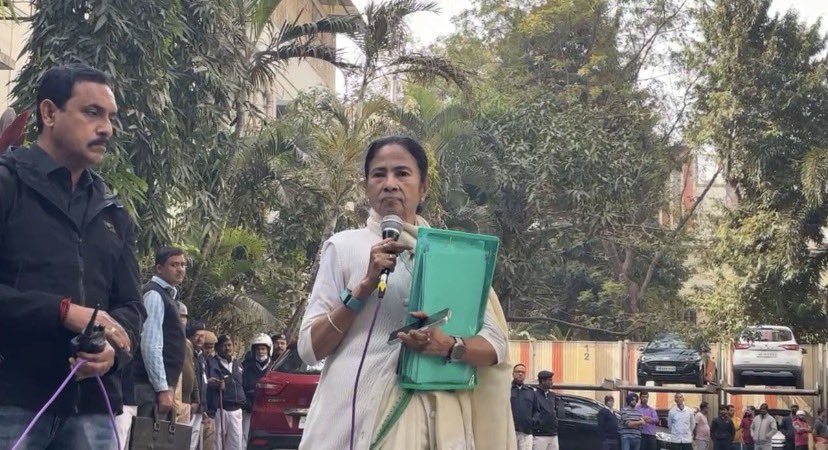
The drama peaked around noon when Mamata Banerjee, accompanied by Kolkata Police Commissioner Manoj Verma, reached Jain’s residence. Emerging later with a green folder, the Chief Minister alleged that officials were attempting to seize the Trinamool Congress’s (TMC) internal candidate lists, campaign strategies, and sensitive digital data.
To understand the gravity of today’s events, you must look at the specific legal and strategic layers that define this confrontation:
1. The “Nasty, Naughty” Quote (Direct Attack)
The most viral part of this event is the specific language Mamata Banerjee used. She didn’t just call it “political vendetta”; she directly attacked the Union Home Minister.
2. SIR (Special Intensive Revision) Connection
Mamata Banerjee linked this raid to a larger electoral conspiracy involving the Special Intensive Revision (SIR) of the electoral rolls . She alleged that the central government is “removing names” from the voter list through the SIR process . Also claimed that they are using the ED to “steal” the TMC’s internal strategies to win the upcoming 2026 assembly elections.
3. The Specific Case: “Fake Job Scam” vs. “Coal Smuggling”
The ED’s official justification is more specific than just “money laundering.” The ED says these searches are part of an investigation into a fake government job scam linked to an organized network. This network used fake official emails and forged appointment letters across 40 government departments. It is presenting this raid not as a political attack, but as a criminal investigation into a scam that defrauded ordinary citizens.
4. The parallel case of “Rajiv Kumar”
Opposition leaders are drawing a historical parallel that contextualizes Mamata’s “on-the-spot” intervention. In February 2019, she famously staged a dharna when the CBI tried to raid the then-Police Commissioner Rajeev Kumar’s house.
5. The argument that “I-PAC is not a party office”:
I-PAC is a corporate company, not the office of a registered political party.Therefore, it does not receive any political exemptions, and the Chief Minister has no legal right to interfere in a raid on the home of a private corporate director.
6. Federal Friction
Many see this as a continued pattern of the “weaponization” of central agencies to intimidate state governments.
Why This Case Matters
This incident is far more than just a local dispute. It highlights a deep breakdown of trust between the state and central governments. While the ED claims it is fighting corruption, the TMC alleges it is fighting “political vendetta.”
The fact that a Chief Minister had to personally “retrieve” documents from the raided premises demonstrates just how tense the situation has become. As West Bengal heads towards the 2026 elections, this “hard drive battle” is likely to be a major issue for voters.
Follow our blog for live updates as this story unfolds.
About the Author