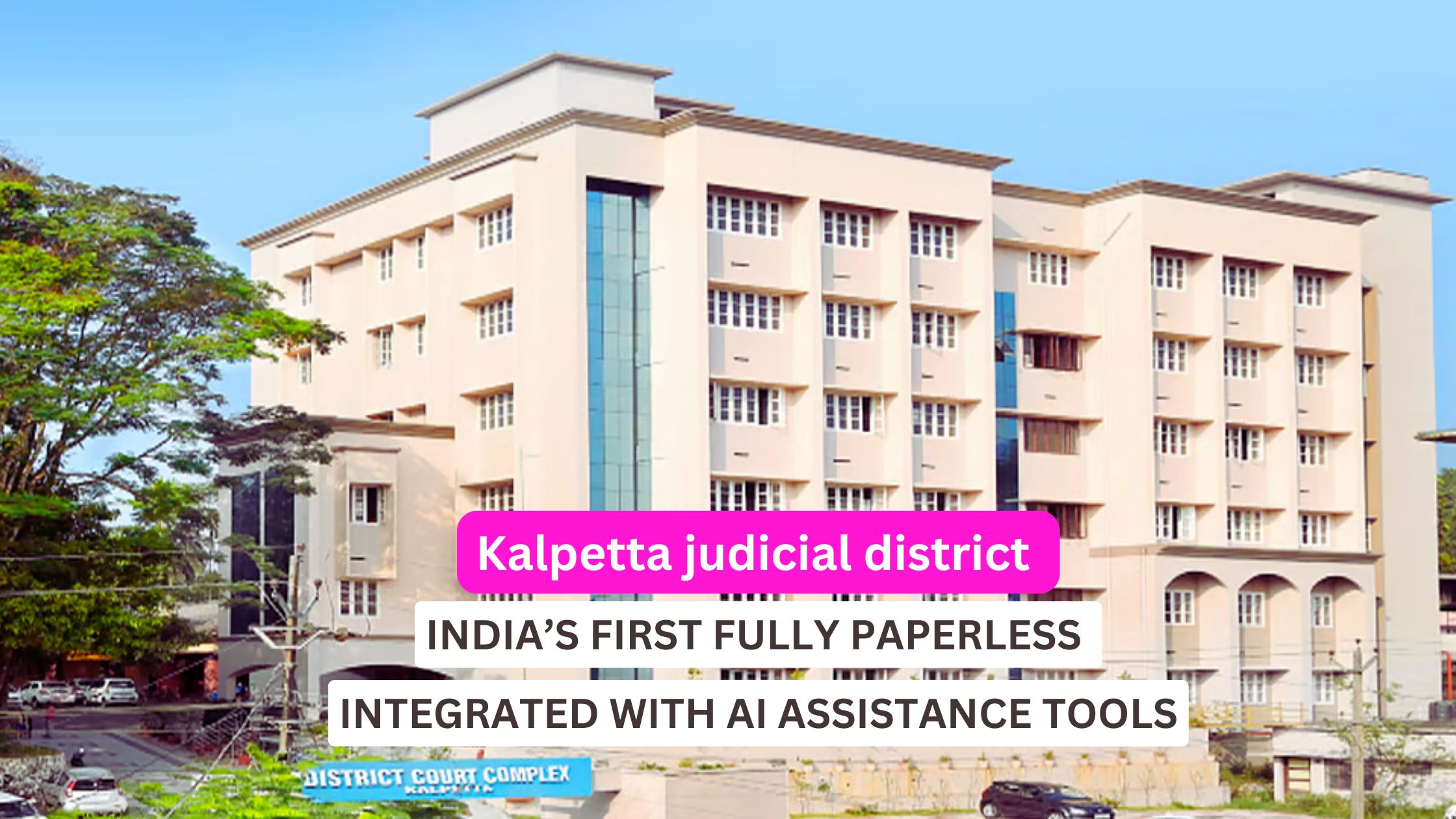
For the first time in India, Kerala’s Kalpetta judicial district achieved a significant milestone in judicial reform by launching virtually the country’s first fully paperless district judiciary. This development marks a new beginning for the entire district court system, which has now fully transitioned to end-to-end digital operations, incorporating AI-assisted tools to enhance access to justice.
From now on all courts in Kalpetta, situated in Wayanad district, will function exclusively in a digital format. All case filings will be submitted electronically, reviewed online, and made instantly available to judges. This whole process will be made possible through the District Court Case Management System, an in-house developed system by the Kerala High Court. It is for easier access to justice to ordinary litigants & MSMEs; to reduce their geographical barriers, cut litigation costs and improve transparency.
AI Integration and Digital Tools
The paperless judiciary is supported by AI-enabled tools that empower judges to:
- Generate structured summaries from electronic case records
- Extract case-specific information
- Digitally annotate documents
Meanwhile, voice-to-text technology ensures accurate transcription of witness testimonies and judicial dictations. Secure digital signatures will provide legal validity to court orders and judgments.
National Significance of the Reform
In his opening speech, the Chief Justice of India referred to this change as a fundamental transformation in how justice is administered, describing it as “green jurisprudence.”
“When we deliberate on the law or the justice system, we often think of it as a monumental edifice, built of stone, tradition, and historically, mountains of parchment. Today, as we inaugurate the paperless courts of Wayanad, we acknowledge a profound shift in our constitutional geometry,” he said. “Tradition is not the worship of ashes but the preservation of fire. We are not changing the law or how it is practised. We are sharpening the tools used to serve it. This is a human-centric transformation where the machine does not replace the mind—it liberates it,” he added.
Justice Vikram Nath, Chairperson of the Supreme Court eCommittee said, “Every reform in the justice system must answer one question: does it bring justice closer to the citizen? Wayanad, often perceived as remote due to its geography, has now become home to one of the most forward-looking judicial reforms in the country,” he said.
About the Author