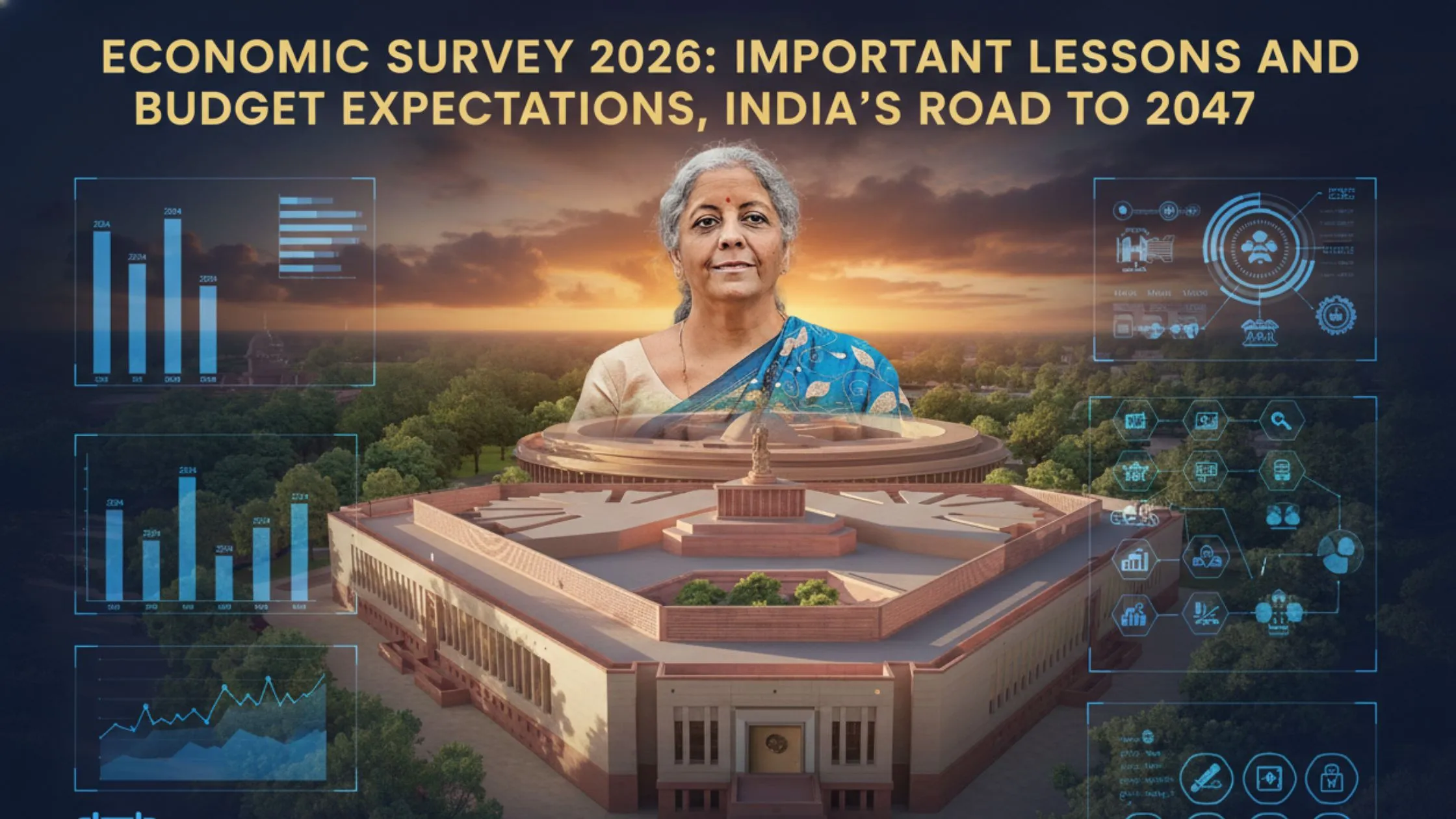
The Economic Survey 2026 was presented to Parliament, January 29, by Finance Minister Nirmala Sitharaman, ahead of the Union Budget 2026 announcement. Since it has been presented, attention is turning to how the government will strike a balance between fiscal consolidation and aggressive capital expenditure (Capex).
This is the first time the India Union Budget presented on a Sunday in at least ten years, and it will be her ninth consecutive budget speech.
1. The Fiscal Balancing Act.
Fiscal consolidation is expected to occur gradually, according to economists. The fiscal deficit expected to be between 4.2 and 4.3 percent of GDP for FY27, with a goal of reducing debt-to-GDP to 50 percent by FY31. High non-tax revenues from the RBI and PSUs are anticipated to assist the government in achieving its current goals, even though tax collections have somewhat moderated due to slower nominal GDP growth.
2. Economic Survey: Sectoral Highlights and Industry Requirements
- Healthcare: Digital and Diagnostic Drive A “Healthy India” roadmap is being demanded by the healthcare sector.
- Tax rationalization: Reducing taxes on medical devices to increase affordability is one of the main demands.
- Infrastructure: Grants specifically allocated to Tier-2 and Tier-3 cities for medical and paramedical education.
- Digital Health: Increasing the reach of rural diagnostics by extending the digital push started in earlier years..
Technology and Fintech: Beyond Assembly
Industry executives are advocating for a change from “Assembled in India” to “Engineered in India.”
- “Deep-Tech: Manufacturers are seeking incentives for domestic R&D of core components like PCBAs and batteries
- Fintech: Resilience and compliance are now the main priorities. The need for regulatory clarity on international payments and AI-based fraud detection is very strong.
- Crypto: Experts are looking for a dedicated Crypto Bill and the rationalization of the 1 percent TDS and 30 percent capital gains tax to boost liquidity and innovation.
Education: The $30 Billion Vision in Economic survey
According to Economic survey press conference, Education leaders propose a $30 billion investment push to reach the 50 percent gross enrollment ratio outlined in NEP 2020.
- Tax advantages on tuition for higher education
- Policy changes to make Indian universities a “global magnet” for students from around the world.
Infrastructure and Real Estate
- Housing Developers are looking for ways to increase demand for housing by improving credit availability and stabilizing interest rates
- Planning: According to experts, cost overruns occur in 55–60% of large projects. There is a demand for the Budget to fund more rigorous “Detailed Project Reports” (DPRs) to prevent execution delays.
Tourism and Gems/Jewellery
- Tourism: Demands that the hospitality industry be given “Infrastructure Status” and that hotel GST be rationalized.
- Jewellry: To reduce illicit trade and increase export competitiveness, the sector is looking to lower import taxes on gold and silver.
3. Renewable Energy (RE) in Economic Survey
The CEO of SAEL Industries underlined the necessity of increased PLI programs and funding to close the viability gap for solar and biomass energy. The objective is still to reach the 500 GW non-fossil target by 2030, which calls for significant investments in upgraded transmission networks and grid-scale battery storage.
4. What to Look Out for Budget 2026
The 2026 Union Budget’s central theme is “Viksit Bharat 2047” (Developed India 2047). And as the Finance Minister gets ready to give the entire budget speech, therefore, everyone’s budget 2026 expectations will be on:
- Income Tax: Possible changes to tax slabs to help the middle class
- 8th Pay Commission: First indications of the financial consequences for FY28
- MSME Support: Digital adoption incentives and streamlined compliance.
Conclusion
The Budget 2026 is a vital first step toward India’s long-term developmental objectives. The government hopes to maintain India’s status as the fastest-growing major economy in the world by bridging the gap between high-level policy (such as the Economic Survey) and ground-level execution (through sectoral incentives).
About the Author