
As the two most powerful leaders in the world prepare to meet, New Delhi is watching very closely. The outcome of the Trump-Xi Jinping talks could directly shape New Delhi’s trade future, its chances of becoming a global manufacturing hub, and its room to manoeuvre between Washington and Beijing.
US President Donald Trump is set to travel to Beijing on May 14 and 15, 2026, for a face-to-face meeting with Chinese President Xi Jinping. It will be the first visit by an American president to China since 2017, and it comes at a time when the world economy is already under enormous pressure from trade tensions, a war in the Middle East, and rising oil prices.
For most countries, this is a story about two superpowers trying to sort out their differences. For India, it is something more personal.
What Is Actually Happening in Beijing?
The summit has been in the making for months. It was originally planned for earlier in 2026 but got pushed back after the United States and Israel launched strikes on Iran. The White House confirmed on March 25 that Trump would visit Beijing on May 14 and 15.
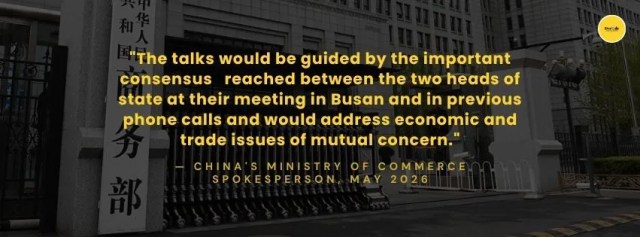
Before the Beijing summit, US Treasury Secretary Scott Bessent is also meeting Chinese Vice-Premier He Lifeng in Seoul on May 12 and 13. This is a preparatory round of talks to set the agenda before the two presidents sit down together. The groundwork is clearly being laid for some kind of economic announcement.
According to the World Economic Forum, both leaders are expected to focus heavily on trade and economic issues. More sensitive topics such as nuclear security, Taiwan, and artificial intelligence may also come up, but economic deals are the likely headline from this meeting.
Key Issues on the Table for Trump-Xi Jinping Meeting:
- Reducing US tariffs on Chinese goods, currently among the highest in decades
- China’s access to critical minerals and rare earths that American industries need
- Technology controls and semiconductor export restrictions
- The ongoing conflict in the Middle East and its effect on global energy supplies
- Taiwan and broader security concerns in the Indo-Pacific region
Why India Cannot Look Away?
Here is the uncomfortable truth for New Delhi. Ever since the US-China trade war began in earnest, India has benefited quietly. Companies that could no longer do business smoothly with China started looking for alternatives. India, with its large workforce, growing infrastructure and relatively open economy, was high on that list.
This trend, known as the “China Plus One” strategy, has seen global manufacturers diversify their supply chains away from China and towards countries like India, Vietnam and Mexico. Indian textile, electronics, and pharmaceutical exports have grown. New factories have come up. The argument that India could one day rival China as a manufacturing base started sounding less far-fetched.
But if Trump and Xi Jinping reach a significant trade agreement in Beijing, that equation could shift. A major reduction in US tariffs on Chinese goods would make Chinese exports competitive again. Businesses that were about to commit to India might wait and watch instead.
“This shift risks undermining the China Plus One strategy that saw firms move manufacturing to India, Vietnam, and Mexico.” — Strategic Affairs Analysis, May 2026
In fact, pre-summit signals are already telling. Earlier in May, the United States and China announced a temporary trade truce after talks in Geneva. For 90 days, US tariffs on Chinese imports are set to drop from as high as 145 percent to around 30 percent. That alone has already narrowed the competitive gap between India and China in the eyes of global investors.
A Double Challenge for New Delhi
India faces a challenge that is both economic and strategic at the same time. On the economic side, India currently enjoys around 10 percent tariff access on goods exported to the United States. That is reasonably competitive. But if China gets a sweeter deal from the Trump Xi Jinping summit, India will need to lock in its own trade agreement with Washington quickly. Otherwise, the proposed 26 percent tariff that the Trump administration has discussed for Indian goods could become reality, and India’s advantage would evaporate.
On the strategic side, India has always tried to keep a careful distance from both the United States and China, avoiding being seen as entirely in either camp. This is the philosophy of “strategic autonomy” that guides Indian foreign policy. But as Washington and Beijing move closer, even temporarily, that middle ground gets harder to hold.
“India had been hoping that the hostility between the US and China would create space for a deeper trade partnership with Washington. Now, with the G2 choosing detente over confrontation, the strategic and economic calculus has shifted.” — Hindustan Times analysis, November 2025
Trump-Xi Jinping: Why are they approaching for talks suddenly?
The US-China trade war has been building for years. During Trump’s first term, tariffs on Chinese goods hit as high as 57 percent, before a partial deal lowered some of those tariffs. When Trump returned to the White House in January 2025, he increased again, raising tariffs as high as 145 percent on Chinese imports. China retaliated with its own duties of up to 125 percent on American goods.
The damage was real. Chinese exports to the United States dropped by nearly 20 percent in 2025. But China did not sit back. It worked hard to find new markets, and by early 2026, China’s total exports had grown by over 21 percent year-on-year. Beijing simply found new customers in Southeast Asia, Africa, and Europe instead.
The two leaders last met in Busan, South Korea, in October 2025. That meeting produced a trade agreement that lowered US tariffs on Chinese goods from 57 percent to 47 percent. Trump reportedly called that meeting a “12 out of 10” success.
The Beijing summit is a much bigger affair. It is a full state visit, the first by an American president to China since Trump’s own first term. The expectations are correspondingly higher, even if experts are urging caution about how much will actually change.
According to the Centre for Strategic and International Studies in Washington, Trump’s visit will “likely represent a relatively modest step toward greater stability and predictability” rather than a breakthrough. The Council on Foreign Relations has noted that China enters the summit from a position of confidence, having diversified its trade partners and weathered the US tariff pressure better than many expected.
What India Should Be Doing Right Now?
Indian policymakers and trade officials are well aware of the stakes. The Ministry of External Affairs has been monitoring the US-China talks closely. There is a broad consensus among analysts that India needs to fast-track its own trade discussions with Washington if it wants to preserve its current advantage.
India has already taken steps to show goodwill. Earlier this year, New Delhi committed to ramping up imports from the United States, particularly in energy and defence. That kind of gesture matters to the Trump White House. But a formal trade agreement, with clear tariff commitments, is what would give India durable protection from the fallout of whatever Trump and Xi Jinping decide in Beijing.
There is also a longer-term argument that India should not depend on the US-China rivalry to drive its growth. Building domestic manufacturing capacity, improving ease of doing business, and investing in infrastructure are things India needs to do regardless of what happens in any bilateral summit between Washington and Beijing.
Looking Ahead: What to Watch After Trump-Xi Jinping Meeting?
Once the Trump Xi Jinping summit concludes, the immediate things to watch for are any joint statements on tariff reductions, announcements about Chinese purchases of American goods, and whether the 90-day tariff truce becomes something more permanent.
For India, the key question is whether a major US-China deal will be accompanied by pressure on other countries, including India, to also renegotiate their trade terms. The White House has already indicated that Trump plans to host Xi for a reciprocal visit later in 2026, which suggests this is the beginning of a longer engagement, not a one-off event.
Indian Prime Minister Narendra Modi also recently visited China for the first time in seven years for the Shanghai Cooperation Organisation summit. That visit, read alongside the Trump Xi Jinping talks, signals that the world’s biggest economies are all hedging their bets and building redundancy into their relationships. India is doing the same.
But the window to turn this moment of global realignment into lasting economic advantage may be narrowing, and New Delhi knows it.


🔥🔥🔥🔥🔥